Friday, 4 July 2014

Canon EOS 5 - Architecture - June

This month's topic is architecture and I am using my relatively new Canon EOS 5 camera (also known as EOS A2 or EOS A2e in America).  This is a professional camera and uses all my modern EF lens from my digital set-up. It is very easy to use and produces excellent pictures - I have no worries about shutters playing up or light leaks around the hinge or any of the other things that plague the user of vintage cameras. The film, as usual, is Agfa Vista + 200 ISO.

I live in the middle of the City of Lincoln - the county town of Lincolnshire and a very old city. People were living here when the Romans arrived in AD 48 although there are no remains of any pre-Roman buildings. We do have some Roman buildings still in use - Newport Arch to the north of the city is Roman and a part of the Roman basilica is still standing, now incorporated into another building. I am afraid I have not included either of these. However, I am continually surrounded by architecture. 

These pictures show some examples of the variety of buildings we have here, sometimes on their own and sometimes juxtaposed with other buildings. Where I know something of the buildings I am going to mention it but most of these are just anonymous buildings to me. They are not in any particular order - just that in which I found them when walking around the city.

If anyone has more information on any of these buildings, I would be pleased to add it.

A mid-20th century house in a gap between Victorian buildings with a late 20th century office block in the background.

An ornate Victorian terraced house. As a bonus, you can see me taking the photo in the downstairs window.

County Hall, Lincoln. Not sure when this was built but I suspect shortly after the Local Government Act 1888.
 

This is a view of the Shed on the University of Lincoln campus It is basically a pub.

This was originally a car showroom and was designed by Sam Scorer in 1959. It uses Scorer's favoured roof style of a hyperbolic paraboloid. It is now a listed building occupied by Nando's restaurant.

The University of Lincoln's buildings seen from across the Brayford Pool. These are the earlier buildings from the late 1990s and early 2000s. Before they were built, the area was disused railway sidings.

The Witch and Wardrobe pub. This is a medieval building that has been adapted to 21st century use. There is a plaque on the wall giving a brief history of the building. 

New(ish) buildings on the edge of the Lincolnshire Co-op's market hall.

The Corn Exchange which was built in 1847 so farmers could trade in their corn harvest ('corn' meaning any cereal grain, not just maize). It now houses a bank and a bookshop.

Barclay's Bank building, Lincoln. This is a late 20th century building which I actually find quite attractive.


Tyhis building now houses Boots the Chemist's shop in Lincoln's High Street. The façade seems to be poured concrete which looks rather dirty to me. I do not like this building.

The HSBC bank building. The legend above the door says "Midland Bank" which is who the building was built for but they were taken over by HSBC in the late 20th century. It is standard ornate, grand design for banks.

A farm building seen in the countryside. I have no idea at all where I was when I took this. It is an entirely functional building in local stone and pantiles and fits its surrounding excellently.

This Lincoln pub tries to be Elizabethan or Jacobean but is actually quite modern, being built in the 1930s to replace an older pub built in 1747. You can tell it is 'new' because all the exterior woodwork is straight and neat, indicating machined wood.

I think this Marks and Spencer building is early 20th century. it is very reminiscent of all those Woolworth shops we used to have in every town.

I think this is a Victorian building - I took the picture because I like the semi-circular gable ends which are reminiscent of Dutch architecture.

A silhouette of a very modern car park and an older gable end and chimney. I just liked the shape it made. 

A detail from the 14th century Stonebow in Lincoln's High Street.

Chimneys.  What more can I say about them?

Two towers of the cathedral and a central modern tower. Again, I just thought it looked good.


Roof line over the Witham. The wood-framed building is a rare surviving building on a bridge. Once upon a time, all bridges had building on them which I think is a good idea - the rents will pay for the maintenance of the bridge!

A bit more of that building-on-a-bridge.


A view along Lincoln's High Street, showing the mix of styles ranging from 1400 to 2000.


An old, abandoned industrial building at Stamp End, Lincoln. Functional design but still attractive.

One of our two high-rise apartment buildings. This is Shuttleworth House named after an industrialist from a bygone age.

A second view of the same building.

Tuesday, 3 June 2014

Ikonta 35 - May 2014


My camera of the month for May is my Zeiss Ikon Ikonta 35.  This is a 35mm camera from the very late 1940s.   It is a nice camera to use (I know 'nice' is not a good word to use here) with no design problems getting in the way.  Using it is very similar to using a folding Voigtlander Vito camera.  The shutter release falls naturally (for a right-handed person) under the index finger of the right hand and the ring finger on the left hand can easily turn the film advance.

My main problem with using this camera was, as with all cameras of this age, the small viewfinder. I have developed a technique now of deciding the framing of the picture without looking through the viewfinder, taking my glasses off and positioning dominant parts of the picture without the view being in focus.  This actually works quite well.

The camera has a fault with the film advance mechanism - possibly two related faults. Sometimes when I try to advance the film, the advance knob will not turn. To get this to turn, I have to put my thumb over the lens (to prevent any light getting in), cock the shutter and release it a second time.  This was necessary four times in a 24 exposure roll of film. This suggests that the double exposure prevention mechanism fails to release the film advance on the first firing of the shutter. The second fault is that sometimes the film will advance two frames instead of stopping at one frame - this happened a couple of times wasting two frames. Apart from these two intermittent faults the camera behaved perfectly. There are no light leaks either from the back or from the bellows, exposure is fine as is focus.

I enjoyed the topic I have chosen for this month - churches. Lincolnshire is well endowed with churches. Their ages range from the 11th century Saxon churches to late 20th century churches. Obviously, I could not photograph all of these - I am limiting myself to one roll of film which means 24 exposures with the Agfa Vista + I have used with this camera.  So, the churches I have photographed have been those around where I live in Lincoln and those I have come across on my birding trips with Bestbeloved.

The churches are:
  • St John the Baptist, Ermine, Lincoln
  • Orthodox Church, Yarborough Road, Lincoln
  • Lincoln Cathedral
  • St Mary's, Frampton
  • St Peter and St Paul, Kirton
  • St Mary le Wigford, Lincoln and St Benedict, Lincoln
Actually, this has led on to a long term project to photograph all the redundant churches in Lincolnshire - there are rather a lot of them and it will take me most of this year to complete this.  When I have, I will publish the photographs in another blog.

The Photographs:

St John the Baptist, Lincoln

This is a modern church built in 1963. I have only photographed the outside but I am told the inside is glorious and I might go back and see if I can photograph the inside. The architect was Sam Scorer and the building is now a Grade Two listed building.


Lincoln Cathedral.


This was built starting in the eleventh century, initially in the Norman (or Romanesque) style but finished in English Gothic.  This tower has just been cleaned and restored and the builders were in the process of removing the scaffolding when I took this picture.

Lincoln cathedral - south western corner.

 St Peter and St Paul, Kirton.

This church was built over several centuries -  Mid C12, late C12, C13, C14, C15, and work has continued on the church up to, and including, the twentieth century.
St Peter and St Paul, Kirton, Lincolnshire

St Peter and St Paul, Kirton, Lincolnshire

St Peter and St Paul, Kirton, Lincolnshire

 St Mary's, Frampton.

There has been a church on this site for a very long time but this church was built from 1350.  As is usual with old churches, the church has been adapted over the centuries to meet contemporary needs. The church as it is now is a very attractive church.

St Mary's, Frampton, Lincolnshire

St Mary's, Frampton, Lincolnshire

St Mary's, Frampton, Lincolnshire

St Mary's, Frampton, Lincolnshire

St Mary's, Frampton, Lincolnshire - gravestone

 St Benedict's, Lincoln City

There was a church on this site from Saxon times and the current church was originally built from 1107 and was mostly demolished in the Civil War. It is currently used by the Mother's Union.
St Benedict's, Lincoln

 St Mary le Wigford, Lincoln City.


This church dates from the 11th century with 12th and 13th century additions. It was restored by the Victorians in 1872, which is rarely a good thing. The church is still in use and has a relationship with The Nomad Trust to provide help for the homeless and vulnerable in Lincoln - I would have thought an excellent use for a Christian building.
St Mary le Wigford, Lincoln


Tuesday, 6 May 2014

Emi K - April 2014

I made two mistakes with my April topic. The first mistake was selecting spring as the subject. You would think that being April there would be a lot of opportunities that cried out "Spring!" but when it came down to it I rather struggled to find 24 spring-like subjects.

The second mistake was deciding to use my Emi K as my camera of the month. I was aware when I started that the return spring in the film advance lever was broken, but the mechanism itself seemed to work OK. As I used the camera it became apparent that the lever was not engaging with the internal mechanism properly and sometimes it took several sweeps to advance one frame.

Using this camera reminded me very much of using my Zeiss Ikon Contina Ic. They have a very similar size, shape and weight - I suspect Emi had the Contina in mind when designing the Emi K. Controls are minimal and are placed on the lens/shutter barrel. The viewfinder is nice and large and centrally placed. However, there are no bright lines for accurate composition.

The only problem I have had using this camera stems from the fact that the return spring  in the film advance lever is broken (as mentioned above). I initially thought that this would mean that I would have to return the lever by hand after winding on the film and otherwise all would be well. in fact, the film advance lever interacts with two sub-systems in teh camera - the double exposure prevention mechanism and the missed frame prevention mechanism. Sometimes I would turn the film advance lever and nothing would happen, sometimes I could not turn it at all without pressing teh shutter release a second time - this did not fire the shutter, it just freed the mechanism. I was never confident that the film was advancing properly. Although the rewind knob turned as I advanced the film - a sign that the film is moving - it did not turn smoothly. Looking at the prints, it is apparent that teh film was not entirely moving as it should - there is slight overlap of frames - but the problem is not severe, just annoying.

Exposure of the film is fine, indicating that the shutter speeds are, at the least, close to the supposed values. I only actually used the faster speeds so I cannot vouch for the slower speeds - it is usually the slower speeds that play up first with old cameras.

Lincoln Stonebow

Lincoln cathedral


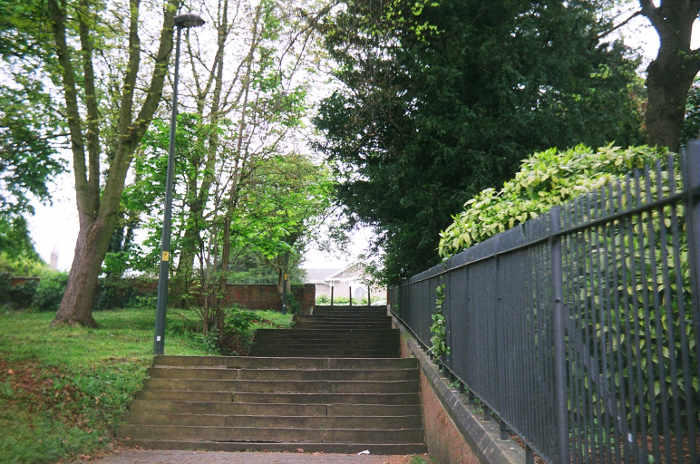
Arboretum steps, Lincoln


two frames superimposed - film advance did not work!


Lincoln alleyway

Caffe Nero window from the inside


Field of rape with some frame overlap


Horncastle market